




Creative Ways to Teach Math
Sajilo Sikshya
2025-12-01
Creative Ways to Teach Math at Home
Mathematics can be viewed as a challenging subject; however, it can also be made playful, interactive, and relevant for children if approached properly. Teaching math at home need not involve endless worksheets or rote memorization but rather creative ways to spark curiosity, build confidence, and make learning delightful. Here are some effective strategies for parents, teachers, and caregivers.
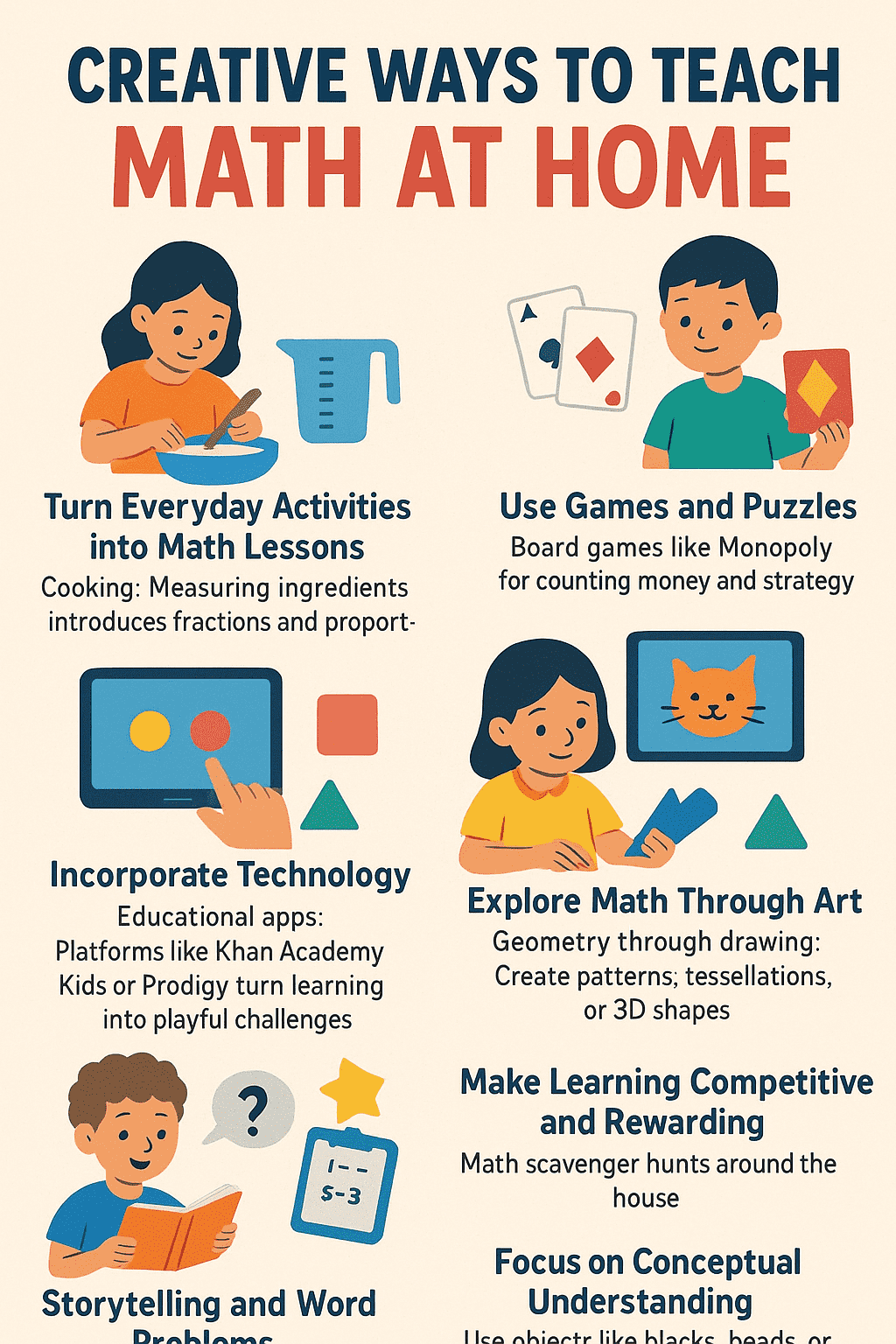
1. Make Math Lessons Out of Everyday Activities
- Math is everywhere! Reinforce concepts with daily routines:
- Cooking: Measuring ingredients introduces fractions and proportions.
- Shopping: Price comparison, discount calculations, and counting money all give practical arithmetic skills.
- Time management: Scheduling events by using clocks or timers teaches addition, subtraction, and other math skills for time.
2. Use Games and Puzzles
- Games make math hands-on and interactive. Try:
- Board games, such as Monopoly, for counting money and strategy.
- Card games for practicing addition, subtraction, or probability.
- Math puzzles, including Sudoku, tangrams, and logic challenges that sharpen problem-solving skills.
3. Utilize Technology
- Digital tools can make abstract concepts more visual and engaging.
- Interactive videos: animated lessons for subjects such as shapes, patterns, and multiplication.
- Virtual manipulatives: Online manipulatives like counters, blocks, or fraction bars are essential to explore concepts visually.
4. Explore Math through Art
- Math and creativity go hand in hand.
- Geometry by Drawing Draw a pattern, tessellation, or 3-D figure.
- Symmetry and measurement: Paper folding for symmetry exercises, making models to explore dimensions.
- Math in music: Rhythm, beats, and scales teach counting, fractions, and patterns.
5. Storytelling and Word Problems
- Story-based mathematics connects learning to real-life contexts.
- Create simple stories involving numbers, shapes, or money.
- Encourage children to write their own math stories and come up with creative solutions.
- Practice problem-solving with scenarios such as building a treehouse or planning a party.
6. Make Learning Competitive and Rewarding
- Friendly competition and rewards may stimulate kids:
- Math scavenger hunts around the house.
- Timed challenges for addition or multiplication.
- Sticker charts or points systems for completed exercises.
7. Emphasis on Conceptual Understanding
- Beyond memorization, help children understand why math works:
- Represent numbers with objects such as blocks, beads, or Lego.
- Encourage children to think aloud, explaining their reasoning.
- Approach problems from multiple perspectives to find solutions, encouraging flexible thinking.
Final Thoughts Teaching math at home can be a joyful journey when approached creatively. By blending everyday experiences, play, technology, art, and stories, children develop not only math skills but also confidence, curiosity, and a love for learning. Keep in mind, the intention is to make math purposeful and interesting rather than just a subject to be completed.